
About
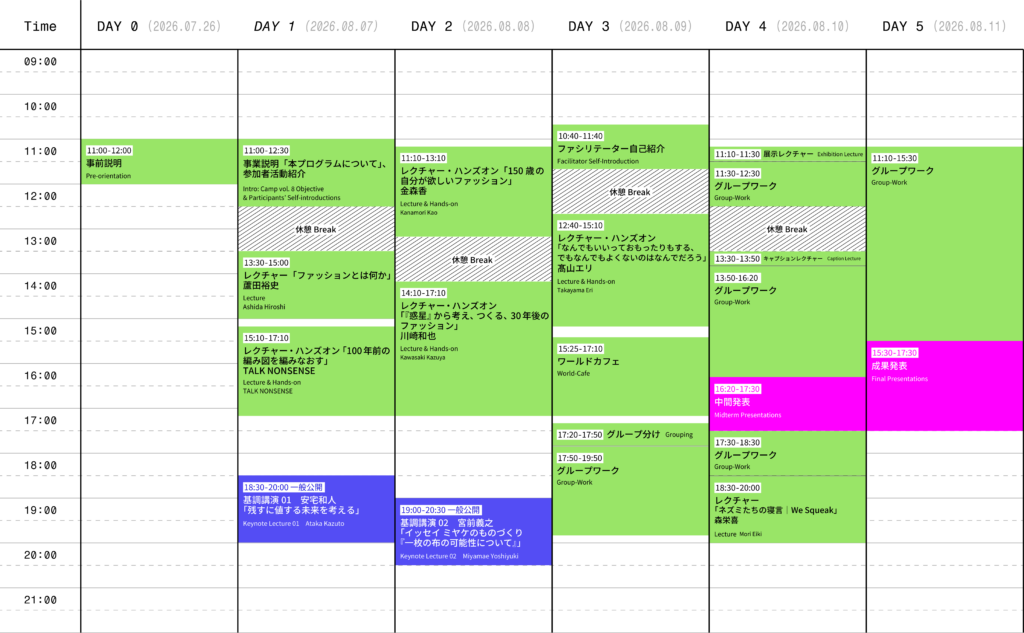
Civic Creative Base Tokyo (CCBT) is hosting another edition of the Future Ideations Camp, its series of short-term intensive workshops bringing together different individuals to engage in creative activities through art and digital technology. Around twenty selected participants take part in several days of lectures for acquiring new ways of thinking, workshops for building skill sets, and collaborative group activities. The general public are also able to attend talks and exhibitions of the results.
This eighth iteration of the camp explores the theme of fashion.
Fashion is the result of an extremely broad and impersonal network encompassing the plants and animals from which materials are sourced, the labor involved in production processes of cultivation, spinning, and sewing, and finally the distribution, consumption, and disposal. By reconsidering clothing not merely as a means of expressing individual identity, but as a mesh of complex layers where different stakeholders intersect, we can envisage the contexts contained within a single garment. A piece of clothing is something we wear, placing it in close proximity to our bodies, and yet is also intricately connected to numerous macro-level issues.
This camp begins by imagining the macro-level contexts related to a single garment, and then jumps thirty years into the future. What kind of clothes will we be wearing three decades from now? In what kind of society will we live when wearing those clothes?
The camp director is Ashida Hiroshi, a professor of design at Kyoto Seika University and specialist in fashion studies. As instructors, the camp also welcomes practitioners with an array of expertise in such fields as engineering, anthropology, and views on life and death. Through lectures and workshops by these instructors, the camp unravels the multilayered and multiplex world of fashion. Through collaborative work done in groups, the participants challenge themselves to create new forms of expression set to transform society thirty years hence.
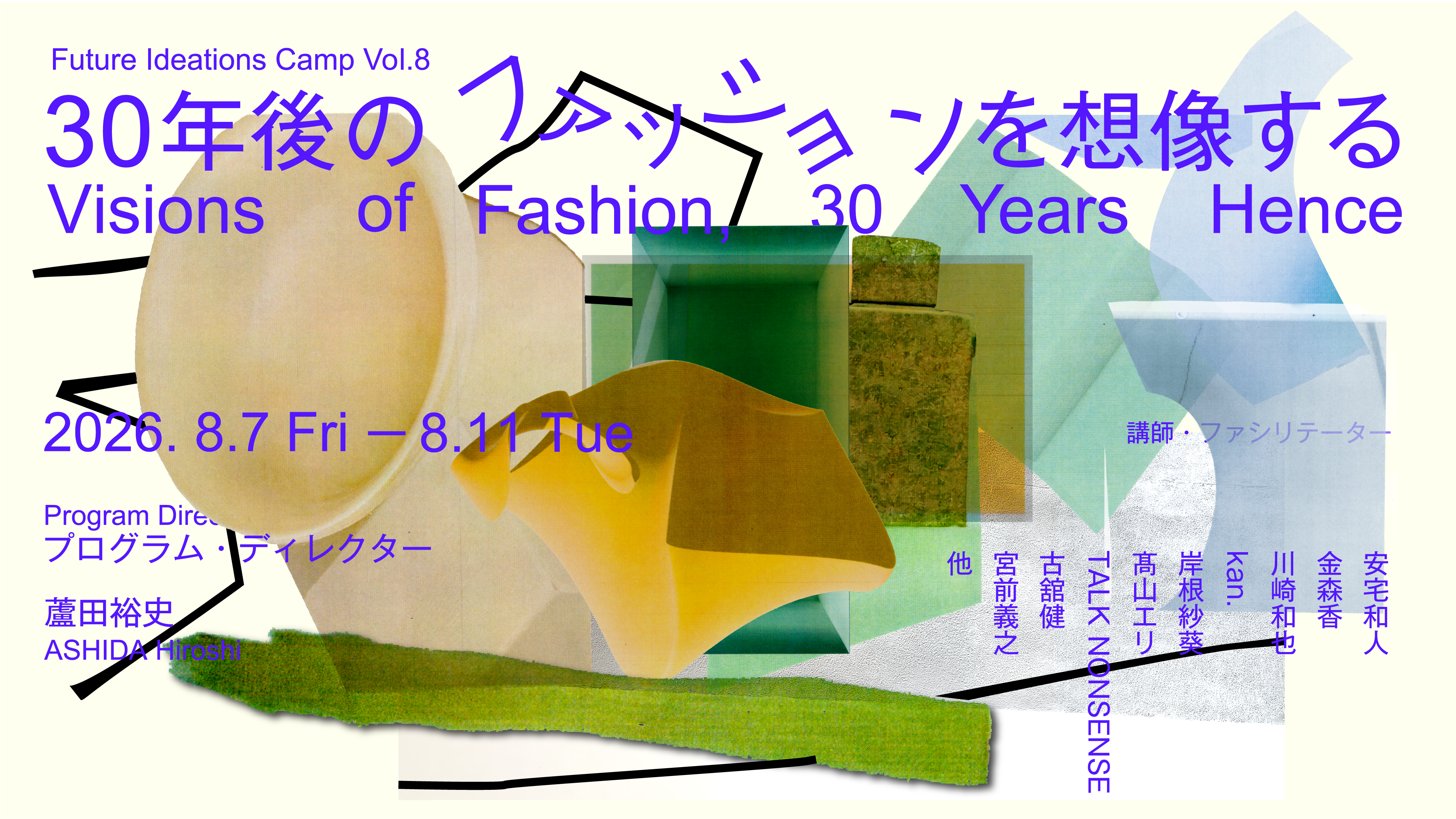
Future Ideations Camp Vol.8:Visions of Fashion, 30 Years Hence
Dates: August 7 (Fri) – August 11 (Tue/Holiday), 2026 (5 days)
Results Exhibition: August 13 (Thu) – August 16 (Sun), 2026
Venue: Civic Creative Base Tokyo [CCBT]
Director’s Statement
“What will you wear tomorrow?” How would you answer this question?
When deciding what to wear tomorrow, you first need to consider what you will be doing: working at the office, going to a theme park with friends, relaxing alone at home, and so on. Clothing choices, however, aren’t determined solely by your own circumstances. You may be constrained by certain rules you must follow, such as is the case with school uniforms, and you might need to adhere to dress codes, especially for formal occasions like weddings and funerals. We also cannot ignore the impact of environmental factors like weather and temperature. And more broadly, your wardrobe is heavily influenced by your finances.
While we live in an era where we can freely choose what we wear, those choices are also heavily swayed by society. Fashion choices are ultimately negotiated in the interstices between individual preferences and societal expectations.
So, what will you or anyone be wearing in thirty years’ time? Perhaps making your own clothes will be the norm, or clothing technology will have advanced so much that whole clothes can be made at just the press of a button, without even need for a sewing machine. Or maybe the very value of fashion—caring about dressing “well”—will have disappeared altogether. Envisioning fashion thirty years hence is incredibly difficult without also imagining what our future society will be like.
This camp is an attempt to encourage participants to explore the possibilities for fashion three decades from now. Some might respond that this is a task more suited to fashion designers. However, a wide range of stakeholders are involved in fashion. Take, for instance, the process of making clothes, which includes many people, each with their own role, from the cotton farmers to spinning mill workers, textile designers, weavers, fashion designers, pattern makers, seamstresses, and more.
Then there are those who project the image of fashion to the public, like the stylists, photographers, and editors, and those who sell the finished clothes. And above all, fashion would not exist without people actually to wear the clothes and accessories in the first place. No matter how brilliantly conceived by a designer, a proposed item of clothing only becomes widespread if people want to wear it. In that sense, there is a need for everyone involved in fashion—to wit, everyone living in society today—to cultivate their imagination.
At this camp, we imagine the ideal form of fashion through thinking, hands-on practice, and discussion. I hope it will be a place for conceiving the as-yet nameless future of fashion.
Ashida Hiroshi
Results Exhibition
Participants
Abe Masashi
Engineer

Itokazu Mio
Graduate student

Inada Yuma
Vocational Student
Omae Yuto
Tatsuno Corporation / Co-Production Department [Production and Development]

OUGA
Designer, Media Artist

Koyama Megumi
Editor

Kazato Mirei
Museum Researcher, Graduate Student
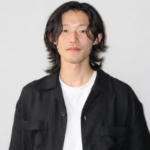
Kaneda Masaya
Engineer

Kawahara Akari
High School Student

Gotanda Ryuji
Vocational Student

Sasaki Sumire
International Art Student

Sasaki Yusuke
Apparel Production Management and Sales

Sakuma Misato
Designer

Shibamura Hibari
Vice Representative and Creative Director of HALMONIUM/Robotics Designer

sen | Furuya Chihiro
Exploring Recording Practices / Research Student

Cha Minhwi
Composer, Sound Artist

Nakagawa Luna
Artist

Momoka Nakayama
Interactive Artist

Nem Hakumei
Artist

Harada Kaoruko
graduate student

Matsubara Toko
University Student

Matsumoto Yuika
Vocational Student

Miyake Rika
Planner
mikio | Okamura Miki
Ph.D. Student, Informatics
Yamaguchi Kana
Graduate Student

Yamazoe Chigusa
Textile Artist

Yu Xin-Min
Designer
Program Director

Lecturers / Facilitators

Ataka Kazuto
Professor, Faculty of Environment and Information Studies, Keio University / Senior Strategist, LINE & Yahoo!

Miyamae Yoshiyuki
designer, A-POC ABLE ISSEY MIYAKE

Kanamori Kao
Representative Director, DRIFTERS INTERNATIONAL / Associate Senior Producer, precog
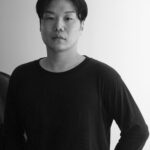
Kawasaki Kazuya
CEO, Synflux / speculative fashion designer

Takayama Eri
stylist

TALK NONSENSE
fashion design, research practice
Mori Eiki
photographer

kan.
textile artist, fashion designer

Kishine Saki
Assistant Professor, Professional Institute of International Fashion

Hiraoka Mao
artist
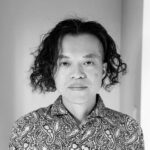
Furudate Ken
artist, musician, engineer

Waki Miyu
editor
Staff
- Program Direction
- Inada Shumpei(CCBT), Ito Takayuki (CCBT)
- Program Management
- Hara Izumi(CCBT), Kobori Tamae(CCBT)
- Technical Direction
- Miura Daiki(arsaffix)、Hirase Miki(arsaffix)
- Technical staff
- Kimura Yusuke(arsaffix), Tanaka Kotaro(arsaffix), Nakaji Hiroaki(arsaffix)
- Operation
- Kanmuri Nanana (Onocoro), Hayashi Keiichi (Onocoro), Murakami Manaka(Onocoro)
- Archive
- Doi miyu(CCBT), Saito Jumpei
- Editor
- Waki miyuu
- Art Director
- Yamaguchi Agata(collé inc.)
- English Management
- Sano Meiko
Cooperation
SINA SUIEN
Spomenik
SOKKYOU
HIDESIGN
HATRA
POTTO
Masakazu Furusawa
MOTOHIRO & CO., LTD.
Tokyo Metropolitan Government, Civic Creative Base Tokyo [CCBT] (Arts Council Tokyo, Tokyo Metropolitan Foundation for History and Culture)