
Passing the Time
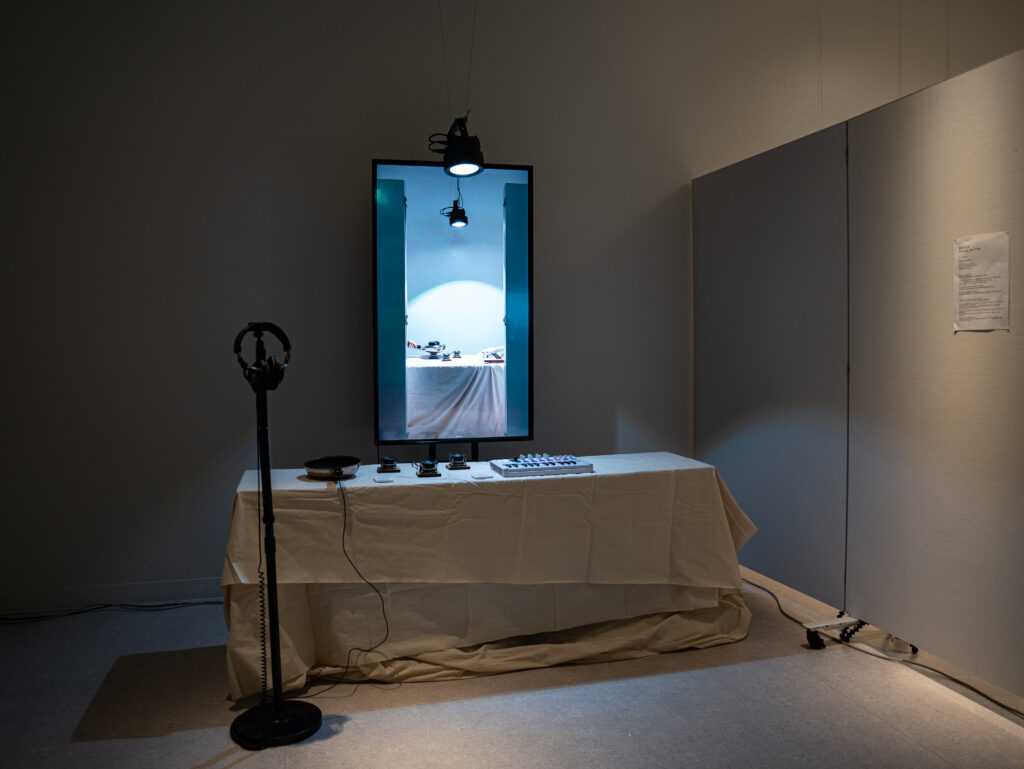
Members: Kansai Takako, J.uuu.N, Takemura Chisato, Alexis Ken Tsujimura, Yatsu Genki
What does it mean to pass the time?
Is there a purpose? Can that purpose be fulfilled?
We have given objects the means and function to achieve our goals, and have called this technology.
However, do we really control these objects that we have created?
Or do we only think that we do?
Here, there are objects responsible for bringing about light, sounds, and movement.
Nevertheless, they play roles different from those we might usually imagine.
What, then, is really here?
Perhaps imagining what is happening before our eyes is in itself a way of passing the time.
Pooling Planets
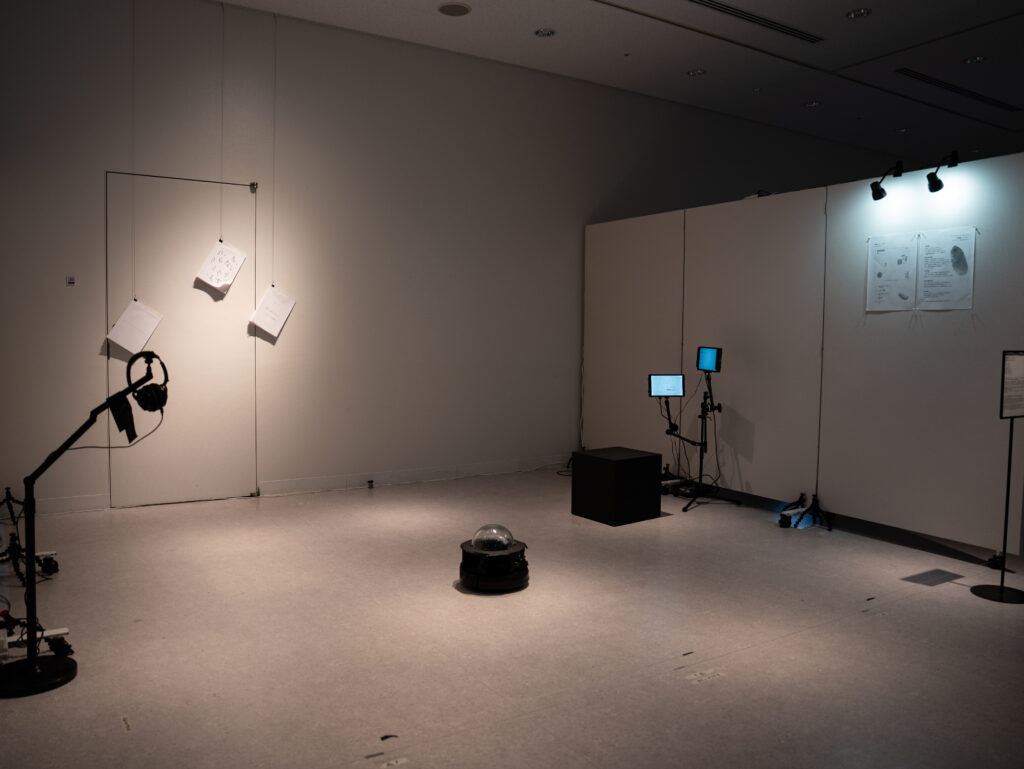
Members: Koki Sakakihara, Sato Hirotaro, Takaguchi Seina, Hashizume Akari, Yoshida Keigo
Fiction has a reality distinct from the world we inhabit. Then, what exactly does emerge when we turn fiction into fiction once again?
Space exploration exists at the frontier of technology: we have devoted vast technological resources to reach for the stars, hoping to discover new technologies in return. Yet, we have occasionally given asteroids and planets mundane names and narratives of their discoveries so that they can be more widely shared and familiarized.
Taking this as our motif, we brought further fictions into being. We 3D-printed an asteroid based on astrophotographs, then used this model to develop songs, devices, words, and bodily movements.
We invited you into this strangely entertaining experience that emerges through the process of “re-fictionalizing fiction.”
PLAY
Members: Inagaki Yusuke, On, Xue Tianle, Nagata Risa, Furukawa Michi
A stone is simply a stone.
No matter how hard we try, however, we cannot escape our perception of seeing stones from the human’s perspective. We have always seen them as something else and have given them various meanings.
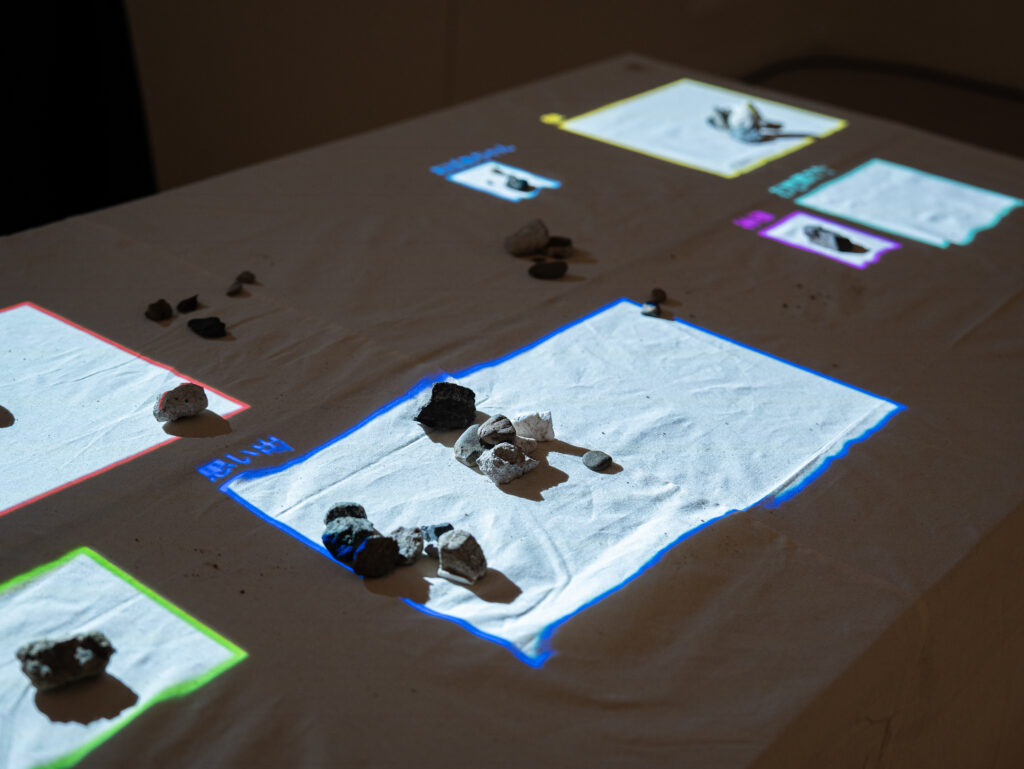
This work seeks to recreate the process by which we give stones meaning. For this, we have invited a few stones to join us.
As the stones perform—play their parts—we invite you to play with them.
The frames projected onto the table are labelled with the different roles. Move and combine the stones to allow these roles to take form.
Perhaps this process is itself a performance of the history we share with stones.
Ugomeku [Wriggling]
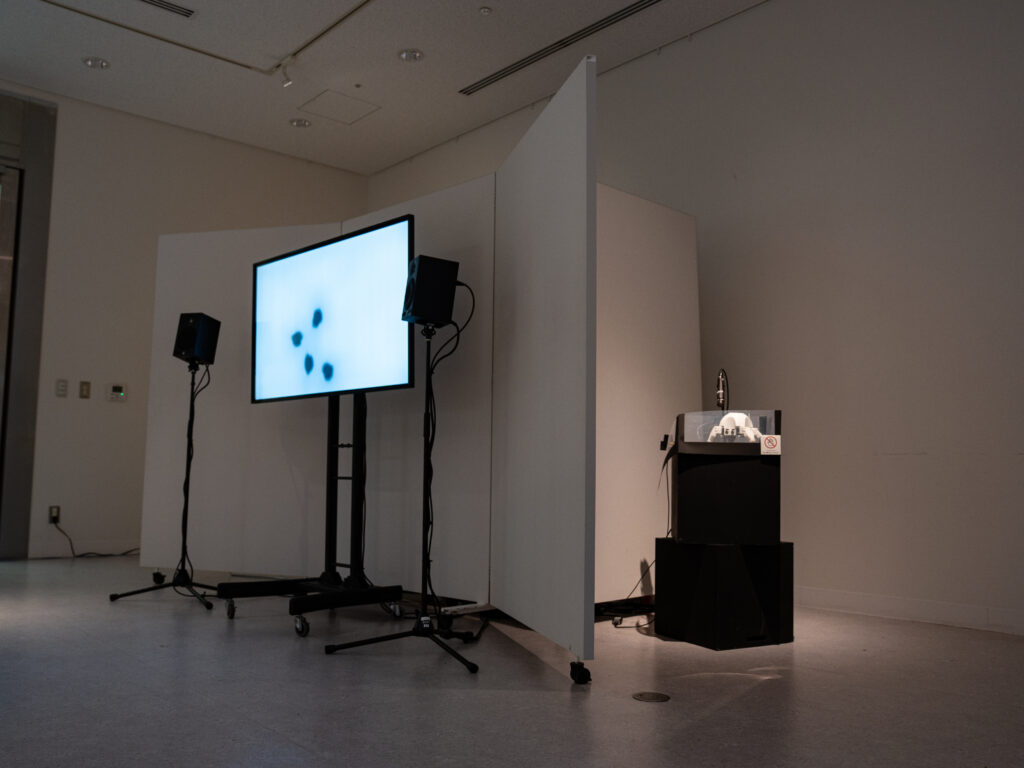
Members: Sugawara Yukihiro, Tanaka Yukari, CHI Yizhou, Miyoshi Shuji
During the past few days, we spent our time with a small entity that wormed around near us.
It didn’t say anything. Nevertheless, perhaps we were absorbing something as it wriggled around. When it stopped or suddenly changed its position, we sensed something there.
Myself, and something else. It is not guaranteed that we would understand each other. Still, I listen closely to it.
Now, all that remains here are the small traces of footsteps and faint sounds.
What is it that you see wriggling here?
Alternative Sitty (Sitting City)
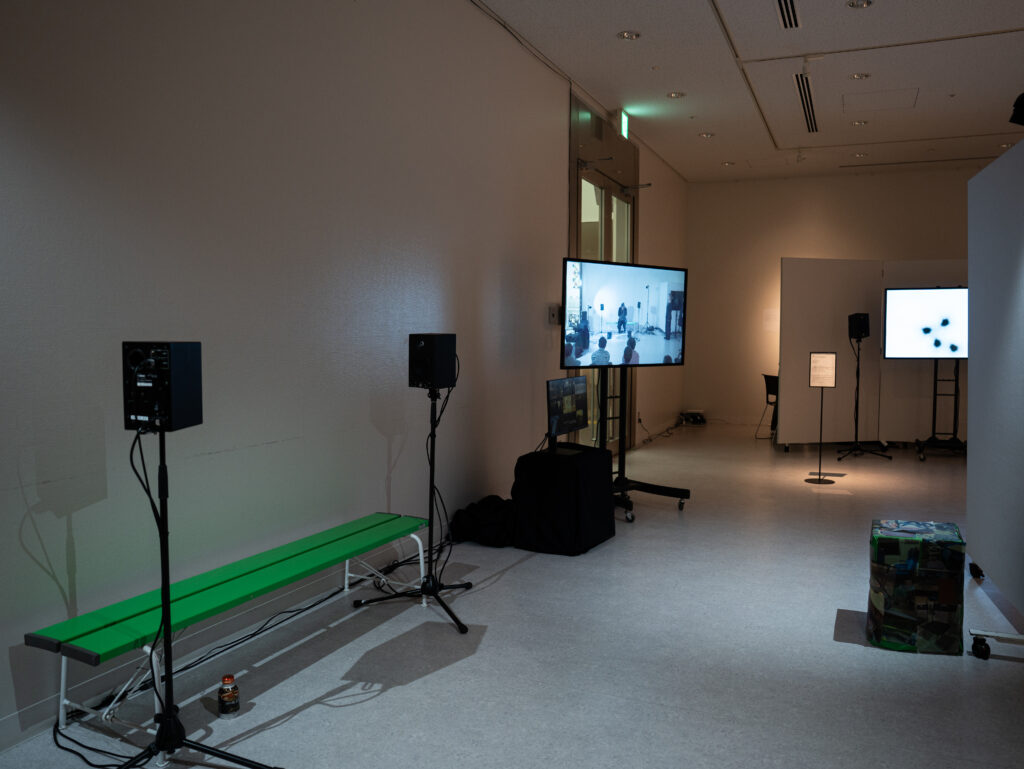
Members: Kaigaishi Nami, Yagi Isaki, Yamamoto Kirie, Lin Wenxuan, watakou
When you sit in a public space—a park or a square—you create your small private space within the city.
However, the boundary between the public and private is all too frail; the warmth of someone sitting next to you, or noise drifting in from somewhere you cannot locate.
When another presence touches you, your body becomes unsettled, and the space between yourself and the other is gradually pushed back. Sat in the chair—unable to leave or drive the other away—you find yourself situated in a push-and-pull relationship: others intrude upon your space, as you intrude upon theirs. Can private spaces coexist? You, too, are likely an “other” to others.
When you get up, only your and the previous sitters’ traces remain; these traces that belong to no one in particular. The next time you sit down in a public space, what will your relationship with the seat (or sitters) beside you look like?