
I Haven’t Talked To You Today
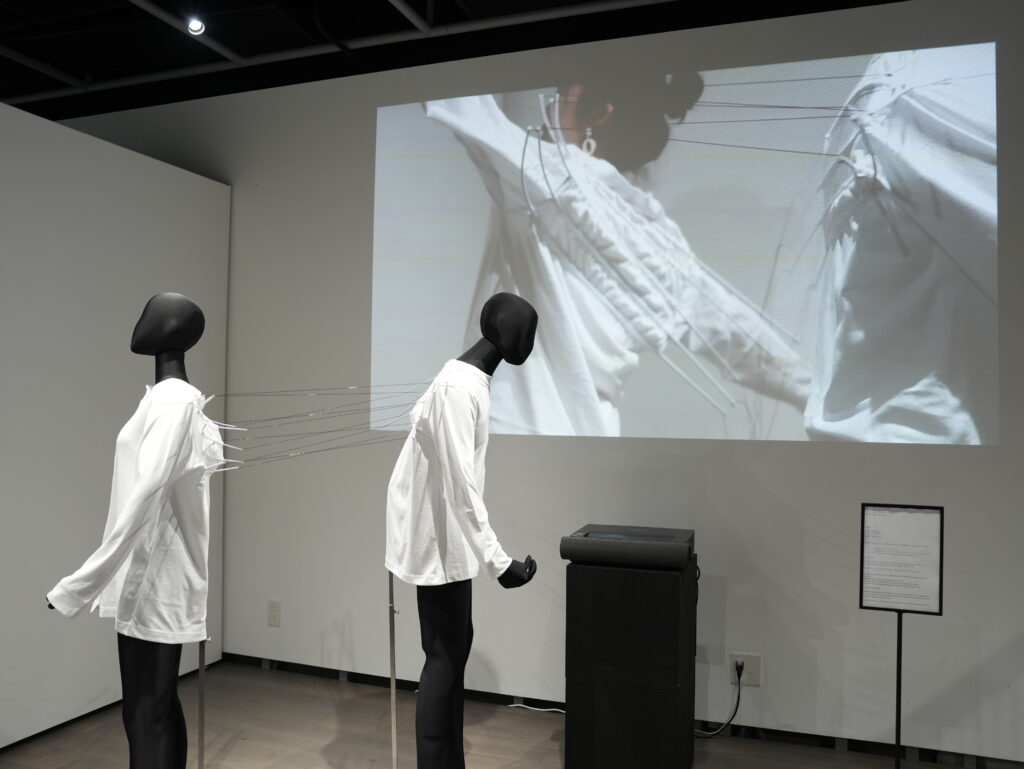
Members: Inada Yuma, Kaneda Masaya, Momoka Nakayama, Harada Kaoruko
On the screen, someone we know can feel far away. On a crowded train, a stranger stands right next to us.
Someone familiar, yet distant. Someone unknown, yet close.
In 30 years, will we feel more distant from one another than we do today, or closer?
This work invites us to sense the presence of ourselves and another through the body.
A garment for two people.
I cannot see the other person, but when they move, I feel the garment pull. In turn, my presence is conveyed to them in the same way. We are connected at a distance where it is hard to tell if we are far or close, strangers or something more.
Even in 30 years time, we will probably not live entirely alone, but alongside the presence of others.
EChO
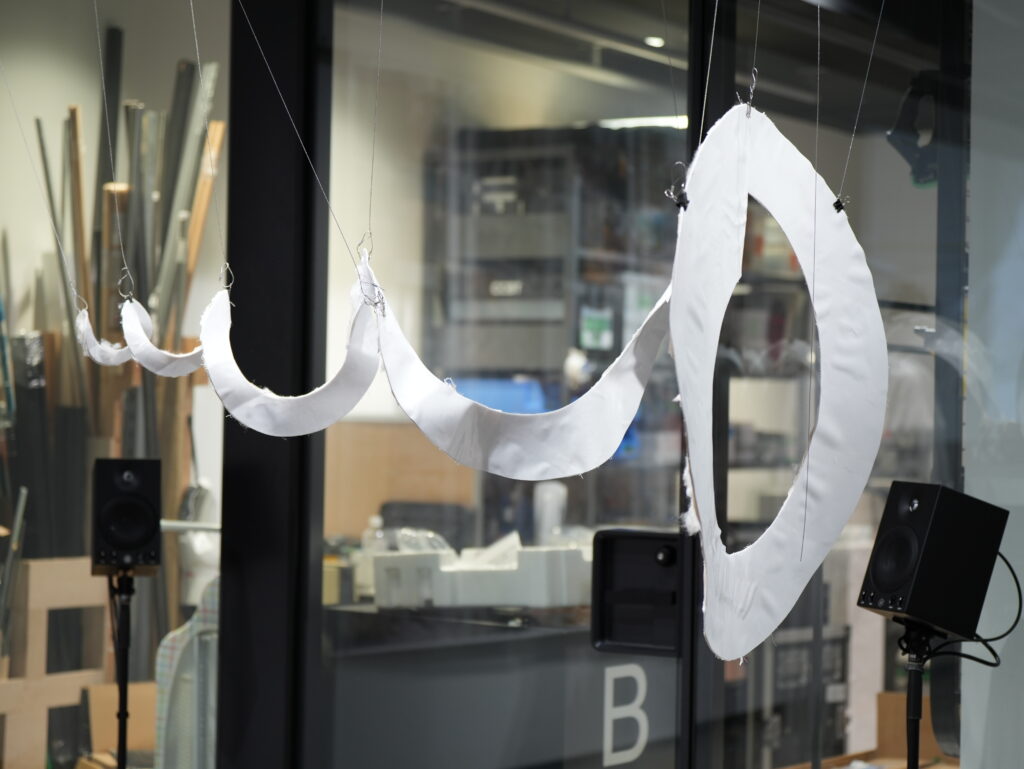
Members: Omae Yuto, Gotanda Ryuji, Cha Minhwi, Matsubara Toko, Yu Xin-Min
When did we start trusting in the “circulation” of things?
We drop off our old clothes into a collection box and assume they will be reused somewhere, even without knowing exactly what happens to it. We also feel somewhat better when we choose recycled materials. Although invisible to us, this idea of circulation has become a kind of quiet, blind faith that supports our everyday choices.
At the same time, hand-me-downs and sashiko repair create a different kind of circulation where
we can see who used the item and who it is passed on to. These items travel from hand to hand carrying with them the time and memories of their owners. What binds them together is love.
In this work, a single piece of cloth represents the two forms of circulation on its front and back, its ends joined to form a helix. Depending on the viewpoint, the circulation appears to taper off or open up. Sound generated from the fibers of the cloth travel through the space along this helix, reaching the viewers’ senses.
In 30 years, what will we call “circulation,” and what will we choose to trust?
When is a piece of clothing complete?
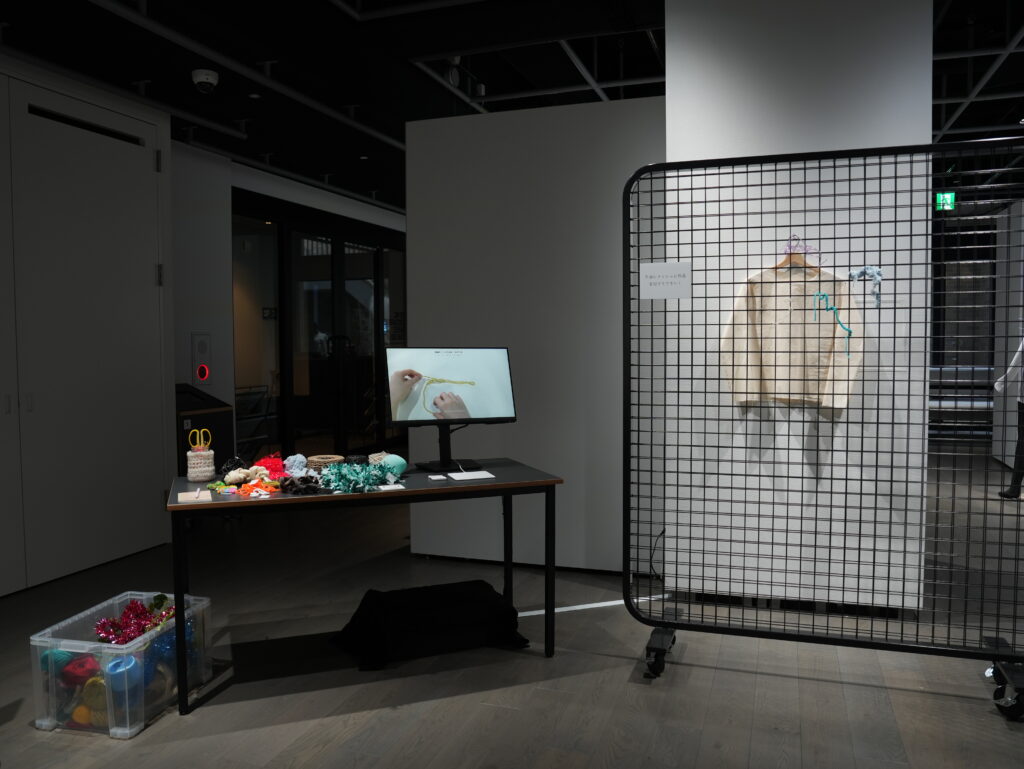
Members: Itokazu Mio, mikio | Okamura Miki, Matsumoto Yuika, Yamazoe Chigusa
The maker’s half, the wearer’s half.
—Issey Miyake
A piece of clothing is only complete when someone wears it.
When we make clothes, we always imagine the unknown wearer.
We could say that this unknown wearer is the “negative space” where we project our hopes and imaginations for the future.
We approached “fashion 30 years from now” as “fashion that still remains 30 years from now.”
When our imaginations for that negative space stretches far into the future, perhaps clothing could endure the test of time. When clothing is passed on to the next generation and styled in new ways, its completion is also carried forward in time.
As you stand in front of this work, you are, for us, that unseen negative space.
Please choose your materials, knit them as you wish, and tie them onto the mesh panel: yarn, metal, chains, craft pipe cleaners, jump ropes, rubber tubes.
Each new knot evokes a piece of clothing that does not yet exist.
As you tie, we invite you to think about a future that is 30 years from now.
With each wearer, a different future—and a different form of fashion—will come into view.
COM·SIGNALS 2056
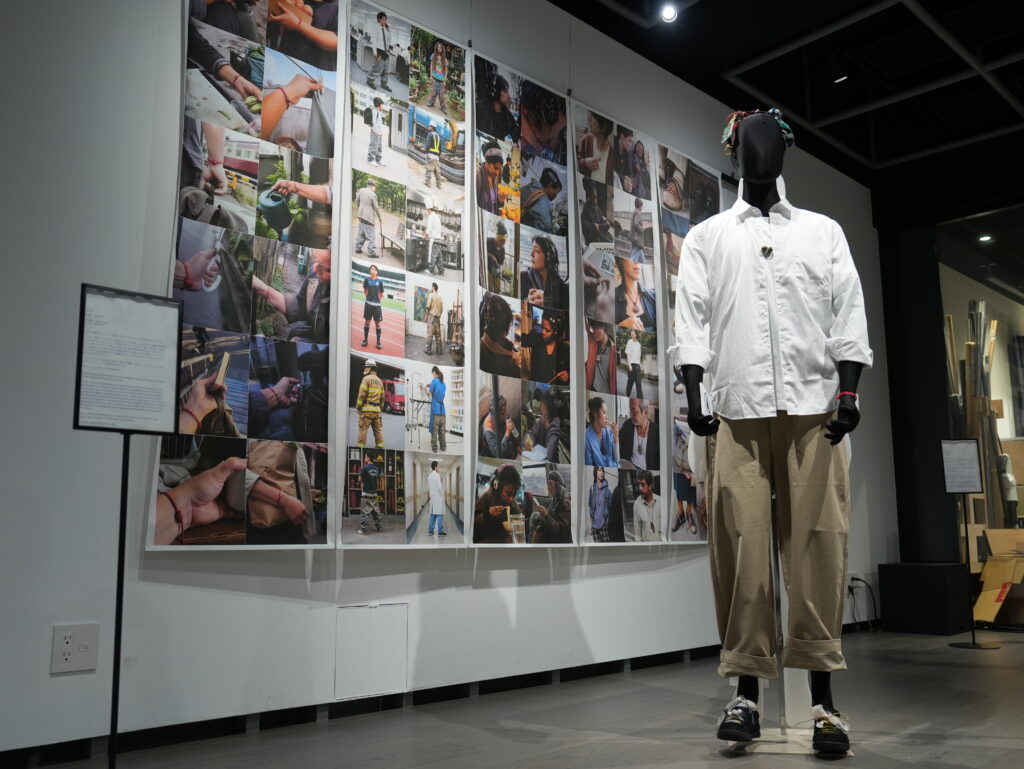
Members: Abe Masashi, OUGA, Sakuma Misato, Miyake Rika
People have long shaped themselves and their boundaries by piecing together experiences formed through relationships with different communities.
In 2056, pseudo-personalities created by information services and AI have permeated everyday life, and people live by selectively choosing the information and relationships that best suit them. In this world, new types of connections that are yet to be named and relationships that are difficult to articulate are accepted as elements that shape a person. While it becomes possible to connect with others without sharing the same place or physical presence, opportunities to meet in person, sense each other’s presence, and influence one another may decrease. The appearance of the city may gradually become more uniform. Nevertheless, people will likely continue to seek others with whom they can share cultures and values, to reassure themselves what and with whom they are connected to.
Fashion still holds the potential to communicate these un-nameable relationships and values through “ways of dressing,” enabling people to find one another.
This work imagines such a world in 2056.
distance :2056
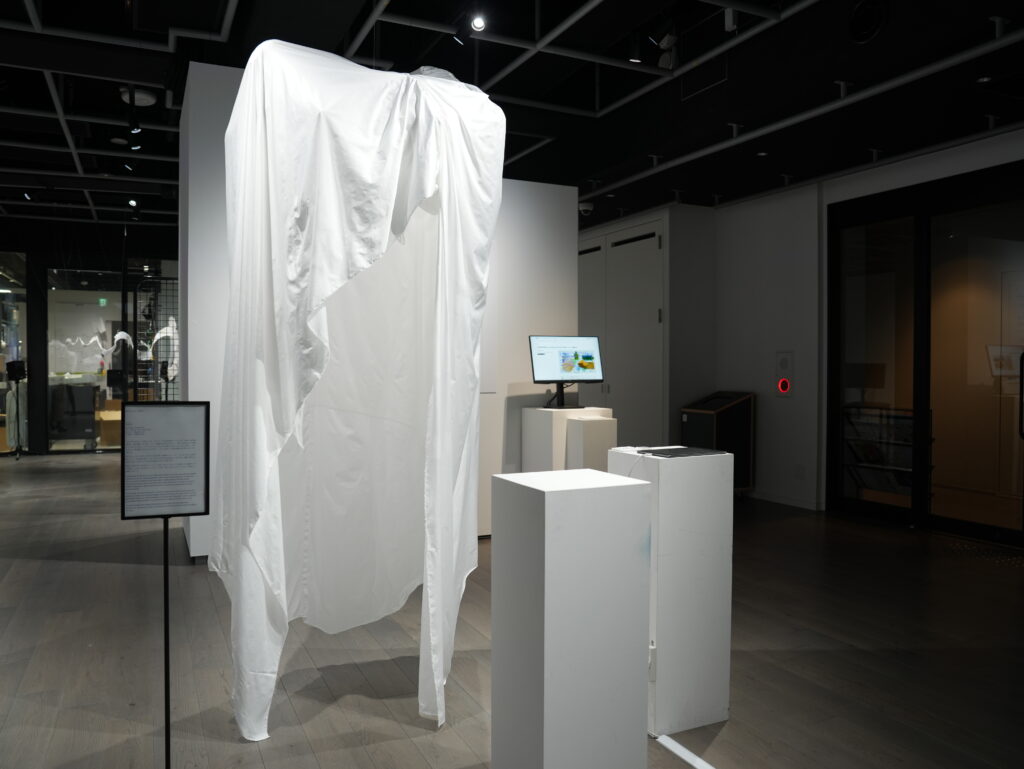
Members: Sasaki Sumire, sen | Furuya Chihiro, Nakagawa Luna, Yamaguchi Kana
A single piece of cloth can cover your naked body outdoors or, of course, you could wear whatever clothes would you like. Rising temperatures, harsh UV rays, sudden downpours—30 years from now, our choices in clothing may be more limited to protect ourselves from these kinds of environmental change. Even so, we will still want to wear what we like, for ourselves. So what if, instead of adapting our clothes to the environment, we could carry a comfortable environment around ourselves?
From this idea, we took the fitting room—a loosely enclosed space where we dress/undress and confront our bodies—as a motif, and created a small, personal space. No matter what the external environment may be, you can wear whatever you like inside your “fitting room.” It is not a space for you to adapt to the environment; it is a space that lets you wear what you like, when you like.
The accompanying audio captures the discussions and research we accumulated while brainstorming. We invite you to listen in and share this process of questioning, exploring, imagining the future.
A Device to Feel Warmth
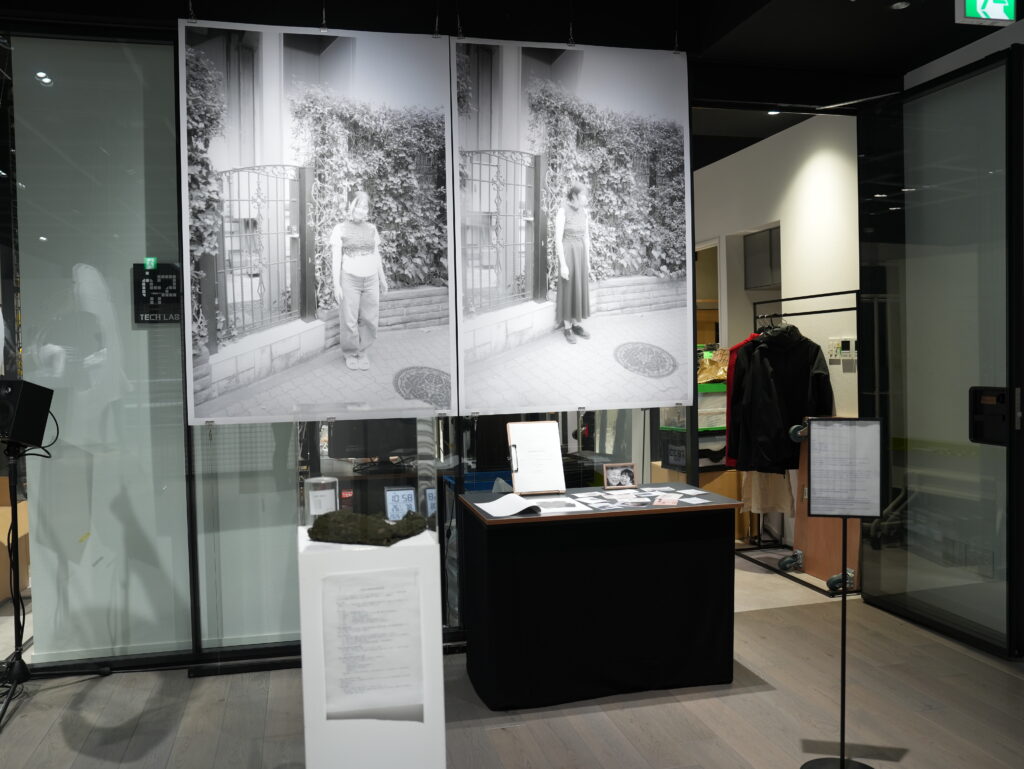
Members: Kazato Mirei, Kawahara Akari, Koyama Megumi, Sasaki Yusuke, Shibamura Hibari, Nem Hakumei
And soon, weary by the dreary morning……An exquisite pleasure had invaded my senses, something isolated, detached, with no suggestion of its origin.
—Marcel Proust
In the near future, not so far from now, the person you care about who is by your side may no longer be there. A few days after my grandmother passed away, a box arrived in my hands. Inside were the clothes she always wore, carrying the scent of days gone by. When I opened the box, it brought back memories of our time together and filled me with warmth.
Timeline box is a device that carries a piece of clothing from the present into the future, along with the memories and warmth infused into it.